
Your Portfolio Is Down: 5 Ways to Stay Calm
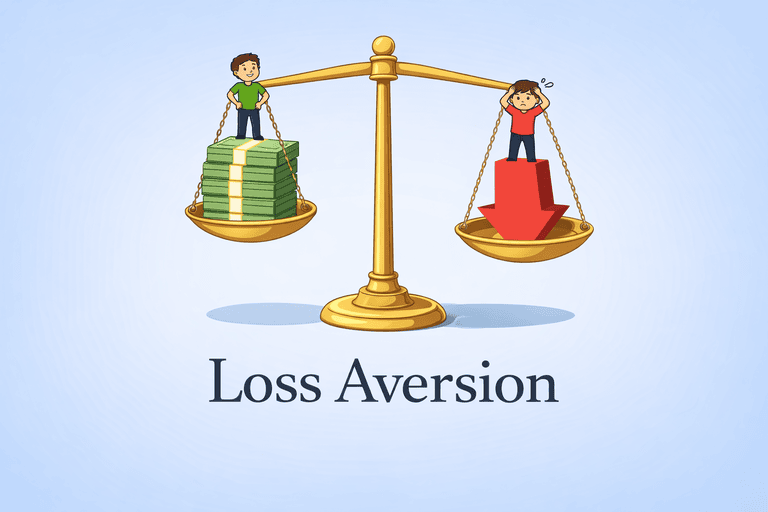
Picture it: you put $10,000 into the market. A few months later, it’s $9,000. Then $8,500. You’re checking your account before breakfast, reading every headline, and quietly wondering whether you should just sell and make it stop.
If that feels familiar, you’re not doing anything wrong. You’re experiencing the most normal part of investing, and the part almost nobody warns beginners about.
Why Stock Market Declines Are Normal for Long-Term Investors
When most of us picture a market decline, we picture 2008 or 2020. But the S&P 500 dips far more often than the big crashes suggest, and most of those dips are small.
Here’s how often it has happened since 1954:
| Decline from a peak | How often, on average | Average time from peak to bottom |
| 5% or more | About twice a year | 46 days |
| 10% or more | About every 18 months | 135 days |
| 15% or more | About every 3 years | 256 days |
| 20% or more | About every 6 years | 402 days |
On a $10,000 portfolio, a 5% dip is $500 and a 10% dip is $1,000 gone from your screen. It stings. It also happens constantly.
Here’s the part that surprises people. Since 1980, the S&P 500 has dropped about 14% at some point within the average calendar year. Yet it still finished the year higher in 33 of those 44 years. A rough ride in the middle of the year doesn’t mean the year ends badly.
A 20% fall has a name, a bear market, and those can last longer and take real time to recover from. But most declines are not bear markets, and knowing the difference is half the battle.

The best days tend to show up at the worst times
Markets don’t only fall. Some of their strongest gains have come soon after the lowest points.
Capital Group looked at every S&P 500 decline of 15% or more from 1929 to 2022. On average, the index gained about 52% over the following 12 months.
Take a hypothetical $10,000 that falls 20% to $8,000. A 52% gain from there would lift it to $12,160, above where it started. That’s the average, though, not a promise. Those results ranged from a loss of 86% to a gain of 138%, so treat 52% as a pattern, not a forecast.
There’s also a quiet piece of math worth knowing. After a 20% drop, you don’t need a 20% gain to get back to even. You need 25%, because you’re climbing from a smaller base ($8,000 × 1.25 = $10,000). Recoveries need strong rebounds, and rebounds tend to arrive when the headlines still look grim.
Invesco found that 24 of the S&P 500’s 30 best trading days since 1997 happened during just three turbulent stretches: the dot-com bust, the 2008 financial crisis, and the COVID crash.
Nobody can tell you which day the turn will come. But if you sell in fear, you can easily be out of the market when it does.
Five things to do when the numbers turn red
1. Pause before you act.
When you see your portfolio dropping, your first instinct might be to do something about it. You might want to sell, move your money somewhere safer, or wait until the market settles down. But emotional decisions often lead to poor timing. Give yourself a day or two to understand what’s happening before making any major changes. A little patience can help you separate your initial reaction from what actually makes sense.
2. Know what you own.
Not every investment decline means the same thing. If your S&P 500 ETF falls because the broader market is struggling, that’s very different from an individual company experiencing declining revenue, growing debt, or serious management problems. Take some time to understand why your investment is falling. Is it a general market decline, or has something changed about the actual investment? Knowing the difference helps you decide whether to stay patient or reconsider your position.
3. Check your portfolio less often.
Watching your investments fall every few hours won’t make them recover any faster. In fact, constantly checking prices can make ordinary market movements feel much more serious than they really are. If you’re investing for the next 10, 20, or 30 years, you don’t need to monitor every daily movement. Consider checking your portfolio weekly or monthly instead. Give yourself the space to focus on your long-term goals rather than getting caught up in short-term fluctuations.
4. Keep some financial breathing room.
One of the worst situations an investor can find themselves in is needing money while the market is down. Imagine losing your job or facing an unexpected expense while your portfolio is already down 20%. You might be forced to sell investments at a time when you would rather hold them. This is why having an emergency fund and keeping money for near-term expenses separate from your investments is so important. Ideally, don’t invest money you’ll need in the next year or two. Having that financial cushion makes it much easier to remain patient during difficult periods.
5. Trust your plan, but know when to reassess it.
If you invested in a diversified ETF because you believe in long-term market growth, a temporary decline alone isn’t necessarily a reason to change your strategy. However, staying invested doesn’t mean ignoring reality. Your financial circumstances might change, your investment goals might shift, or an individual company might no longer deserve a place in your portfolio. Revisit your investments for the right reasons, not simply because the numbers have turned red.
You’re still building something
It’s easy to focus on what your portfolio has lost and forget what you’re actually trying to build.
If you’re investing for the next 20 or 30 years, today’s market decline is only one small part of a much bigger journey. You still have time to contribute, accumulate shares, benefit from future growth, and allow compounding to work in your favor.
Think about someone who invests $300 every month. When prices fall, that same $300 can buy more shares than it could before. If the market eventually recovers and continues growing, those additional shares can become meaningful over time.
Of course, recovery isn’t guaranteed, and lower prices don’t automatically make every investment a good opportunity. But for someone with a suitable long-term strategy, a market decline doesn’t have to mean the end of progress.
Your portfolio might be down today, but that doesn’t mean your financial future is going backwards.
Final Thought
Investing is easy when everything is going up. The real test comes when your account is red and nobody can tell you when it will turn.
The goal isn’t to stop feeling worried. It’s to understand your investments well enough that worry doesn’t make the decisions. A decline is rarely the end of the story. More often it’s a chapter in a much longer one.
Remember this: a falling market is the cost of being invested, not a sign that you’ve made a mistake. Your job is to feel it and keep your plan anyway.
Recommended Reading
The Simple Path to Wealth — JL Collins
A straightforward and beginner-friendly guide to building wealth through long-term investing. It explains the value of simplicity, low-cost index funds, and staying committed to your investment strategy through market ups and downs.
Disclosure: Some links in this article may be affiliate links, meaning Pathidon may earn a small commission at no extra cost to you.

Stefan Theron
Founder of Pathidon
Stefan holds a degree in Psychology and an MBA, and has spent years studying behavioral finance, market psychology, and the decision-making patterns that shape how people invest — bridging the gap between financial knowledge and human behavior.