
How to Avoid Panic Selling in a Market Crash (Investor Psychology Guide)
The Moment That Defines You as an Investor
Market crashes don’t test your portfolio. They test your psychology.
When prices of gold, crypto, or equities start dropping sharply, something deeper than logic takes over. Your brain shifts from analysis to survival. Losses feel immediate and personal. The urge to “just get out” becomes overwhelming.
This is where most investors fail—not because they lack intelligence, but because they underestimate the power of their own emotions.
Behavioral finance pioneers like Daniel Kahneman and Amos Tversky showed that humans are not rational decision-makers under stress. We are wired to avoid pain, even at the cost of long-term success.
Panic-selling is not a strategy. It’s a reflex.
Why Panic-Selling Feels So Right (But Is So Wrong)
At the core of panic-selling is a concept called loss aversion.
Kahneman and Tversky found that losses hurt roughly twice as much as equivalent gains feel good. So when your portfolio drops 20%, your brain doesn’t see it as a temporary fluctuation—it sees it as a threat.
This leads to three powerful psychological traps:
1. The Illusion of Control
Selling feels like taking action. It gives you a sense of control in a situation where you feel powerless.
But in reality, you’re often locking in losses at the worst possible time.
2. Recency Bias
Your brain assumes what’s happening now will continue. If the market is falling, it feels like it will fall forever.
History says otherwise—but fear drowns out history.
3. Herd Mentality
When everyone else is panicking, it becomes incredibly hard to stay calm. Social proof kicks in.
“If everyone is selling, they must know something.”
They don’t. They’re feeling the same fear you are.
Real-World Example: The Crypto Drop
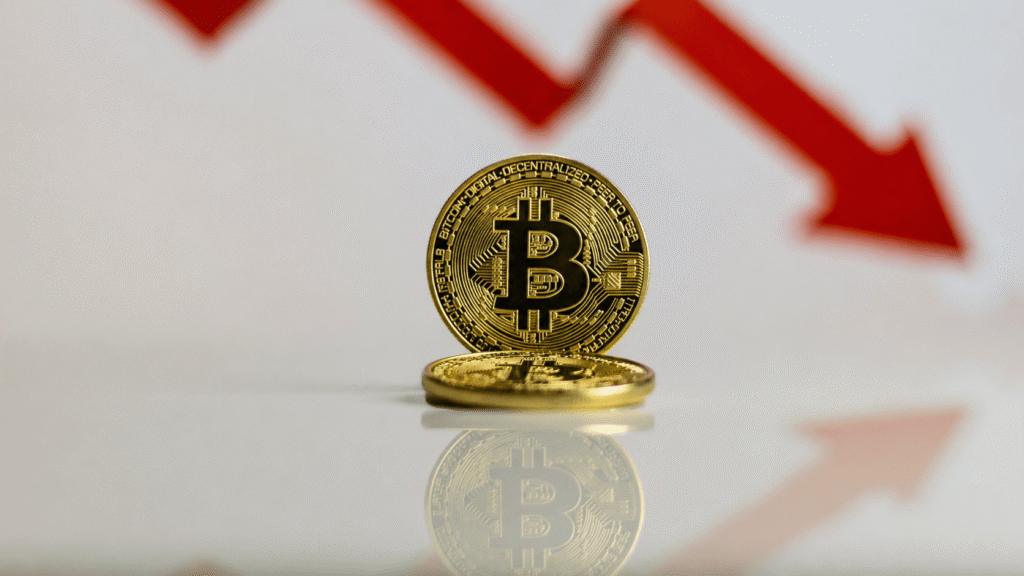
Imagine you bought Bitcoin during the 2021 rally. Prices were climbing toward $64,000, sentiment was euphoric, and confidence felt justified. Then in May 2021, the market dropped sharply—at one point falling over 30% in a matter of days.
Your thoughts shift:
“What if it goes to zero?”
“I should have sold earlier.”
“Let me just sell now before it gets worse.”
So you sell.
But the story doesn’t end there. Within months, Bitcoin stabilized—and by November 2021, it had surged to new highs near $69,000. The same pattern played out during the March 2020 crash, when the S&P 500 fell over 30% in weeks, only to fully recover within months.
This is the cycle: emotional selling during sharp declines, followed by recovery without you. It repeats across assets—crypto, stocks, and beyond—not because markets are unpredictable, but because investor psychology is.
The Calm Investor’s Advantage
Investors who succeed during crashes aren’t fearless. They simply have systems that prevent emotional decisions.
Richard Thaler, a Nobel laureate in behavioral economics, emphasized that small structural changes in decision-making environments can drastically improve outcomes.
In investing, that means building psychological guardrails before the crash happens.
Practical Strategies to Avoid Panic-Selling
1. Pre-Commit to a Plan
Before volatility hits, define your rules:
- At what point would you actually sell?
- Under what conditions would you hold?
If you don’t decide in advance, your emotions will decide for you.
2. Zoom Out Intentionally
During crashes, narrow thinking dominates. You focus on short-term losses.
Force yourself to zoom out:
- Look at 5-year or 10-year charts
- Revisit your original investment thesis
Perspective reduces panic.
3. Separate Price from Value
A falling price doesn’t automatically mean a bad investment.
Ask:
- Has the underlying asset fundamentally changed?
- Or is this just market sentiment shifting?
Most panic-selling happens when price is mistaken for value.
4. Limit Exposure to Noise
Constant checking amplifies stress.
Prices, headlines, social media—they all feed emotional reactions.
Create distance:
- Check your portfolio less frequently
- Avoid doom-driven news cycles
Clarity comes from space.
5. Use Position Sizing as Emotional Insurance
If a position is large enough to cause panic, it’s probably too large.
Right-sizing your investments reduces emotional pressure and allows you to think clearly under stress.
A Different Way to Think About Crashes
Instead of seeing crashes as threats, consider reframing them as tests of discipline.
Anyone can invest when markets are rising.
But real investors are defined by what they do when things fall apart.
Crashes expose:
- Whether you had a real strategy or just optimism
- Whether your decisions were thoughtful or reactive
- Whether you’re investing… or just participating
Final Thought: The Decision You’ll Remember
Most investors don’t ruin their returns through bad picks.
They ruin them through bad decisions at the worst possible moments.
Panic-selling feels safe in the moment. It feels like protection. But more often than not, it’s the exact action that locks in regret.
The goal isn’t to eliminate fear—that’s impossible.
The goal is to build a system that holds you steady when fear shows up.
Because when the next crash comes—and it will—the most important asset you own won’t be gold, crypto, or stocks.
It will be your ability to stay calm when everyone else can’t.

Stefan Theron
Founder of Pathidon
Stefan holds a degree in Psychology and an MBA, and has spent years studying behavioral finance, market psychology, and the decision-making patterns that shape how people invest — bridging the gap between financial knowledge and human behavior.