
Long-Term Investing: The Psychology of Thinking in Decades, Not Days
Why becoming a better investor often starts with changing how you think about time.
Let’s be honest. Investing sounds pretty simple when you explain it.
You put money into investments, give them time to grow, and hopefully end up in a better financial position than when you started.
Then you open your investing app on a random Tuesday morning.
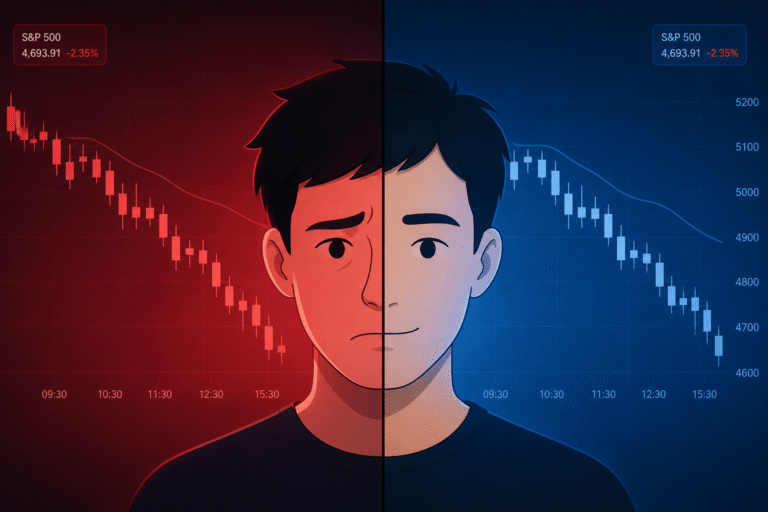
Your portfolio is down 4% in one week. Someone on Reddit is talking about a stock that’s about to explode. And a stranger on social media claims they doubled their money in a few months.
Suddenly, your long-term plan doesn’t feel quite so exciting anymore.
Maybe you should sell something. Perhaps you should buy that stock everyone’s talking about. Maybe you need to do something.
And that’s where investing gets interesting.
One of the hardest parts of investing isn’t choosing what to buy. It’s learning to think in a timeframe that allows your decisions to work.
Our brains weren’t built for 30-year investment plans
Imagine planting an olive tree in your garden. You know it will take years to grow. You wouldn’t dig it up every week just because it hadn’t produced any olives.
Yet investors do something remarkably similar with their money.
They invest for 30 years, then judge their decisions based on what happened this week.
Part of the reason is that our brains pay more attention to immediate rewards and threats than to distant outcomes. A gain today feels real. A potential gain in 30 years is much harder to appreciate.
Losses can be especially uncomfortable. Behavioral finance has a name for this: loss aversion. We tend to feel losses more strongly than equivalent gains, so a falling portfolio can trigger an urge to act even when nothing about your plan has changed.
So when your portfolio falls, you might feel an urge to act, even when nothing fundamental about your long-term plan has changed.
Your financial goals are years away. Your discomfort is happening right now.
And the present can be very persuasive.

The problem with checking your investments every day
There’s nothing wrong with checking your portfolio regularly. The problem begins when checking turns into reacting.
You open your investing app before breakfast. Your portfolio is down. You check again at lunch, and it’s down a little more. By dinner, you’re wondering whether your entire strategy is wrong.
But what has actually changed?
Your goals might be the same. Your time horizon might be the same. And the investments you own might not have changed in any meaningful way.
Your emotions, however, have been on a roller coaster.
There’s a difference between responding to new information and reacting to discomfort.
Sometimes a falling share price signals a genuine problem that deserves attention. Other times, it’s simply a normal part of investing.
Learning to tell the difference is far more valuable than trying to predict every market movement.
How to practise thinking long-term
You don’t need to become emotionless to become a better investor. You simply need habits that make it easier to follow your plan.
- Know why you invest. Give every investment a purpose, and understand what would make you reconsider owning it.
- Set rules before emotions take over. Decide what kinds of changes deserve your attention before markets become stressful.
- Stop comparing your journey with everyone else’s. Someone else’s short-term gains don’t tell you whether your strategy is right for your goals.
- Review your progress in context. If you’re investing for retirement in 30 years, a disappointing week rarely tells you much about whether you’re on track.
And remember, thinking long-term doesn’t mean holding every investment forever. Businesses deteriorate, risks change, and personal circumstances evolve. Patience is valuable, but it isn’t a substitute for sound judgment.
The goal is to remain engaged without becoming consumed by every market fluctuation.
The real advantage of thinking in decades
Here’s what makes long-term investing so challenging: you have to accept that you won’t know what happens next.
You won’t know whether the market will rise next week or whether your investments will outperform next year. Trying to eliminate that uncertainty can lead to unnecessary trading, chasing recent winners, and abandoning sensible plans too early.
Thinking in decades offers a different approach. It encourages you to build a plan that accounts for uncertainty instead of pretending you can avoid it.
Sometimes progress means making a thoughtful decision. Sometimes it means recognising that you don’t have enough information to act.
And sometimes, it’s watching the market do something uncomfortable, reviewing your plan, and deciding that nothing needs to change.
That might not feel exciting, but it can be a sign of disciplined decision-making.
A final thought
Imagine looking back at your investing journey 30 years from now.
You probably won’t remember every day the market rose or every week your portfolio fell. What may matter much more is whether you developed sustainable habits, managed risk sensibly, and avoided decisions driven by panic or excitement.
You can’t control every outcome. But you can control what deserves your attention and how you respond to uncertainty.
The next time your portfolio moves sharply, take a breath and ask yourself: has something important changed, or am I simply reacting to something that feels important right now?
You’re not building a financial future one trading day at a time. You’re building it through the decisions you make, the habits you maintain, and the mistakes you learn to avoid along the way.
So give yourself permission to think a little bigger than today’s market.
Your future self might thank you for it.
Recommended reading
Your Money and Your Brain — Jason Zweig
Why do we make emotional decisions with money, even when we know better? This book explores how the brain responds to financial gains, losses, and uncertainty, helping readers understand the psychological forces behind their investing behaviour.
A great companion read for anyone who wants to understand not just how to invest, but why sticking to a sensible strategy can be so difficult.

Stefan Theron
Founder of Pathidon
Stefan holds a degree in Psychology and an MBA, and has spent years studying behavioral finance, market psychology, and the decision-making patterns that shape how people invest — bridging the gap between financial knowledge and human behavior.