
Investor vs. Trader: What’s the Difference and Which Is Right for You?
Two people can buy the same stock for completely different reasons.
You buy a stock because you believe the company will be worth more in five or ten years. Someone else buys the exact same stock because they think it will rise 5% over the next few days.
Same stock. Same market. Completely different game.
That’s the basic difference between an investor and a trader.
And understanding that difference matters because one of the easiest ways to get into trouble is to start investing like a trader—or trading like an investor—without realizing you’ve changed the game.
What Is an Investor?
An investor focuses primarily on the underlying value of an asset and its ability to create wealth over time.
When an investor buys a company, they’re asking:
“Is this a good business, and do I believe it can become more valuable over the next several years?”
They might look at:
- Revenue and earnings
- Profitability
- Debt
- Competitive advantages
- Management
- Industry trends
- Valuation
- Long-term growth
An investor’s time horizon is usually measured in years or decades. They don’t necessarily sell just because the stock price falls. If the underlying business remains strong, a lower price may even look like an opportunity.

What Is a Trader?
A trader focuses primarily on price movements and shorter-term opportunities.
Instead of asking:
“What will this company be worth in ten years?”
A trader might ask:
“Where is this stock likely to go over the next few days or weeks?”
Traders may use:
- Price patterns
- Momentum
- Volume
- Technical indicators
- Market sentiment
- News
- Economic data
Trading can mean anything from holding a position for minutes to several months. The key difference isn’t simply how long you hold something. It’s how you’re trying to make money.
| Investor | Trader | |
| Main focus | Business & value | Price movement |
| Typical horizon | Years/decades | Days/months |
| Main question | “What is this worth?” | “Where is the price going?” |
| Common tools | Fundamentals | Charts & market data |
| Main goal | Build wealth | Capture price movements |
Neither approach is automatically better.
They simply require different skills and different mindsets.
Let’s Use Apple as an Example
Imagine Apple is trading at $200.
“Apple has a strong ecosystem, loyal customers, and enormous cash flow. I believe the company can continue growing for years.”
They buy the stock. If Apple falls to $170, they ask:
“Did something fundamentally change?”
If the answer is no, they may simply continue holding. A trader might buy Apple at $200 because the stock is showing strong momentum. If it falls to $170, their original thesis may be broken. They might sell.
Same stock. Completely different reason for owning it.
Time Changes the Game
One of the biggest advantages investors have is time.
For example, if $10,000 compounds at an average 8% annually:
- After 10 years: $21,589
- After 20 years: $46,610
- After 30 years: $100,627
That’s the power of compounding.
Investing doesn’t necessarily require you to constantly find the next winning trade. It can simply require you to give good investments enough time to work.
Trading Is a Different Challenge
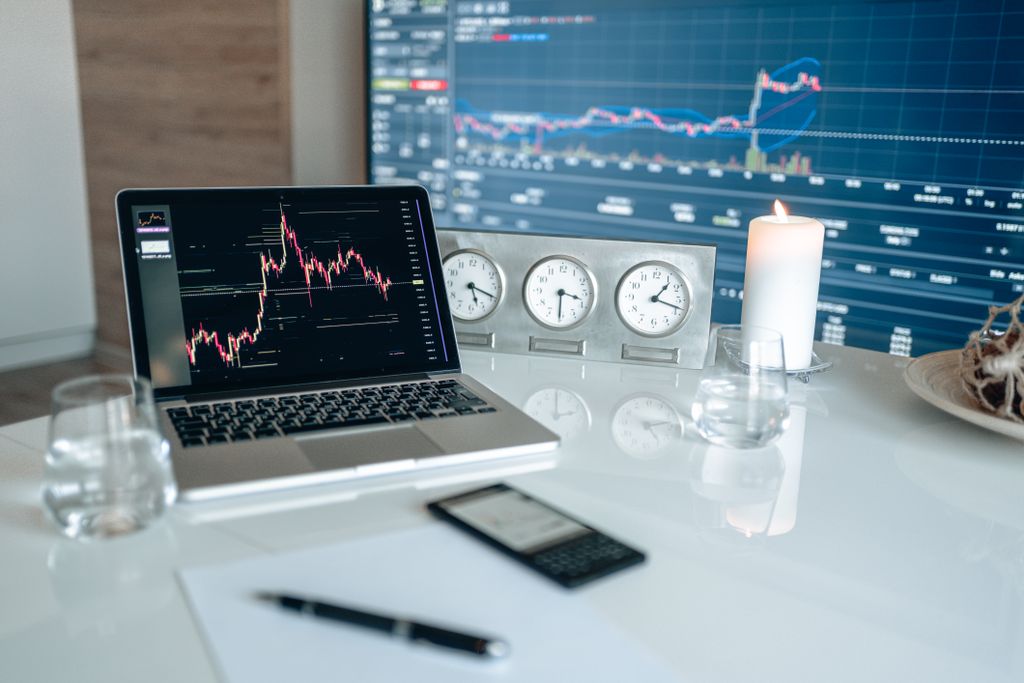
Trading involves making many more decisions.
When to enter.
When to exit.
How much to risk.
Where you’re wrong.
What happens if the trade moves against you.
And being right isn’t enough.
Suppose you make 20 trades and win 12 of them. That’s a 60% win rate. You can still lose money if your eight losing trades are much larger than your twelve winning ones.
This is why successful trading requires much more than predicting whether something will go up. It also explains why, when researchers actually measured how individual traders perform, the results were so consistent.
The Data Is Humbling
Researchers Brad Barber and Terrance Odean studied 66,465 households and found the most active traders earned 11.4% a year—while the market returned 17.9% over that same stretch. The more people traded, the more they lost to overconfidence.
(That 17.9% was an unusually strong bull market, not a normal year—markets average closer to 9–10%. But the point still holds: even with strong returns on the table, heavy traders left most of it behind.)
It’s not just individuals, either. In 2025, 79% of professional large-cap fund managers underperformed the S&P 500—experts with research teams, still losing to a plain index fund most of the time.
Beating the market consistently is hard. For anyone.
So Should You Be an Investor or a Trader?
For example:
Investor: You buy a diversified ETF, invest $500 every month, and plan to hold for 20+ years. A market crash happens, but your long-term plan hasn’t changed.
Trader: You buy a stock because you expect short-term momentum. It moves against you, so you follow your predetermined exit and move on to the next opportunity.
Neither is automatically wrong.
The problem is mixing them up.
If you buy a stock expecting a short-term gain, it falls 25%, and you suddenly tell yourself you’re a “long-term investor” because you don’t want to sell—that isn’t a strategy.
It’s a reaction.
The Behavioral Psychology
This is where things get personal. Investing isn’t just about numbers—it’s about how you behave when those numbers start moving. Three patterns explain most of what goes wrong:
Loss aversion. Losses hurt roughly twice as much as equivalent gains feel good. So when the market drops 20%, the pain drowns out the logic that got you in—and you start checking prices every hour, looking for a reason to act.
The disposition effect. The tendency to sell winners too early and hold losers too long. It’s a big reason traders underperform: not bad picks, but bad timing on letting go.
The hot-hand fallacy. A few wins in a row can feel like skill, even when it’s mostly luck. This is what’s behind “I’ve figured out the market”—right before the risk management disappears.
This is the Apple example again, just with the emotional layer added. The investor and the trader aren’t seeing different data when Apple drops to $170—they’re seeing the same $30 drop. What actually decides whether the investor calmly holds or panic-sells, and whether the trader cleanly exits or freezes hoping it “comes back,” isn’t the price. It’s whether loss aversion and the disposition effect are steering the decision instead of the original plan.
None of this means you’re a bad investor or trader. It’s just how people are wired.
The real risk isn’t the decline. It’s letting one of these patterns quietly rewrite your strategy mid-plan, without deciding to.
The fix: decide your time horizon, strategy, and exit rules before your emotions get involved—not while they’re already in the room.
Final Thought
Investor or trader?
The important thing isn’t choosing the “better” one. It’s understanding which game you’re playing.
An investor is generally trying to let business growth and compounding do the heavy lifting.
A trader is trying to capture price movements through repeated decisions.
Both can work. Both can fail.
But they require different skills, different systems, and different psychological strengths.
So before you buy your next stock, don’t just ask:
“Will this go up?”
Ask:
“What exactly am I trying to accomplish with this purchase?”
That question might save you from making an investment decision with a trader’s mindset—or a trade with an investor’s expectations.
Recommended Reading
A Random Walk Down Wall Street — Burton G. Malkiel
If you want to go deeper into why beating the market is so difficult—and why simple, diversified investing can be surprisingly powerful—this is an excellent next read.
Malkiel explores market efficiency, diversification, bubbles, active management and the difficulty of consistently predicting prices.
It fits perfectly with this topic because it forces you to ask a bigger question:
“Do I actually have an advantage over everyone else trying to predict the market?”
That’s a question every investor should ask themselves.
Disclosure: Some links in this article may be affiliate links, meaning Pathidon may earn a small commission at no extra cost to you.

Stefan Theron
Founder of Pathidon
Stefan holds a degree in Psychology and an MBA, and has spent years studying behavioral finance, market psychology, and the decision-making patterns that shape how people invest — bridging the gap between financial knowledge and human behavior.