Dollar-Cost Averaging vs. Lump-Sum Investing: Which Is Better?
When you have money ready to invest, one simple question matters:
Should you invest it all now, or spread your purchases over time?
These are two common approaches: lump-sum investing and dollar-cost averaging (DCA).
The difference is not about choosing the perfect market entry. It is about how quickly your money becomes invested.
What Is Lump-Sum Investing?
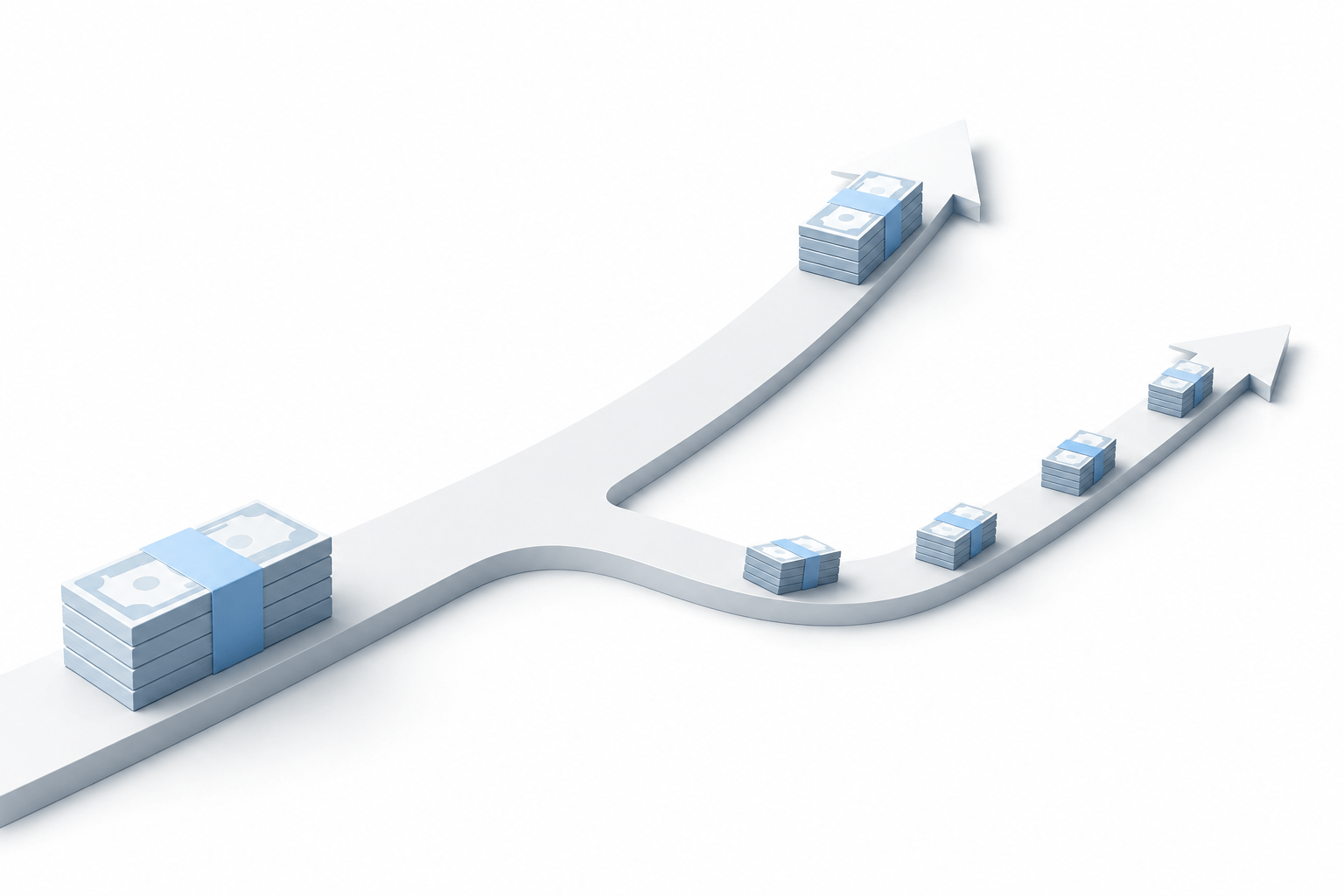
Lump-sum investing means investing your available money immediately.
For example, if you have $10,000, you might invest the entire amount today.
The main advantage is simple: your money spends more time in the market.
If markets rise, your entire investment participates in that growth from the beginning. Historically, this has given lump-sum investing an advantage over spreading the same money out over time. Vanguard research found that lump-sum investing outperformed cost averaging roughly two-thirds of the time across the historical periods it examined.
Of course, there is another side.
If the market falls immediately after you invest, your entire investment experiences that decline.
What Is Dollar-Cost Averaging?
Dollar-cost averaging means dividing your available money into smaller investments made at regular intervals.
For example, instead of investing $10,000 today, you might invest:
- $2,000 today
- $2,000 next month
- $2,000 the month after
- And so on
When prices are lower, your fixed investment buys more shares. When prices are higher, it buys fewer shares.
The advantage is that you are less exposed to the possibility of investing your entire amount immediately before a market decline.
The trade-off is that some of your money remains in cash while the market could be rising.

The Fundamental Trade-Off
The difference can be reduced to one question:
Do you want more time invested, or less money exposed immediately?
| Lump Sum | Dollar-Cost Averaging |
| Invests money immediately | Invests money gradually |
| More time in the market | Less immediate market exposure |
| Higher historical probability of outperforming DCA | Can reduce the impact of an immediate decline |
| Greater short-term downside if markets fall | Greater opportunity cost if markets rise |
Neither strategy eliminates market risk.
DCA simply changes when you take that risk.
What About Trading Costs?
Another factor to consider is the cost of making each investment.
Depending on your broker, buying shares may involve a commission, transaction fee, or currency conversion fee.
If you invest $10,000 as a lump sum, you make one purchase. If you invest it in five separate $2,000 investments, you make five purchases.
For example, a $5 trading fee would cost $5 for one lump-sum purchase, compared with $25 for five DCA purchases.
Many brokers now offer commission-free trading, but investors should still check what their platform charges, especially when making frequent investments.
What About Monthly Investing?
There is an important distinction between DCA and simply investing your paycheck.
If you receive $2,000 every month and invest part of it, you are not really choosing between lump sum and DCA. The money becomes available gradually, so there is nothing to invest before you receive it.
The real comparison occurs when you already have a large amount of cash available but deliberately choose to invest it gradually.
Which Approach Makes Sense?
For someone with a long investment horizon, lump-sum investing has the mathematical advantage of getting capital into the market sooner.
But DCA can make sense if investing everything immediately would make you uncomfortable or increase the chance that you panic and abandon your plan after a market decline.
The most important thing is to have a clear strategy and stick with it.
The Psychology of Investing
The mathematics may favor investing sooner, but investors are not calculators.
Watching a large portfolio fall shortly after investing can be emotionally difficult. DCA can make that experience easier because not all of your money is exposed immediately.
That does not make DCA a higher-return strategy. It simply means that the best strategy on paper is not necessarily the strategy an investor can comfortably follow.
Final Thought
Lump-sum investing prioritizes time in the market.
Dollar-cost averaging prioritizes reducing immediate exposure.
If you already have the money available, history generally favors investing sooner. But the difference matters less if your chosen strategy keeps you invested for decades.
The goal is not to predict the perfect entry point.
The goal is to get invested—and stay invested.
Recommended Reading
The Little Book of Common Sense Investing — John C. Bogle
John Bogle’s classic book explains the fundamentals of long-term investing, including diversification, low costs, and the power of compounding. It is particularly useful for understanding why staying invested can matter more than trying to predict short-term market movements.
Disclosure: Some links in this article may be affiliate links, meaning Pathidon may earn a small commission at no extra cost to you.

Stefan Theron
Founder of Pathidon
Stefan holds a degree in Psychology and an MBA, and has spent years studying behavioral finance, market psychology, and the decision-making patterns that shape how people invest — bridging the gap between financial knowledge and human behavior.