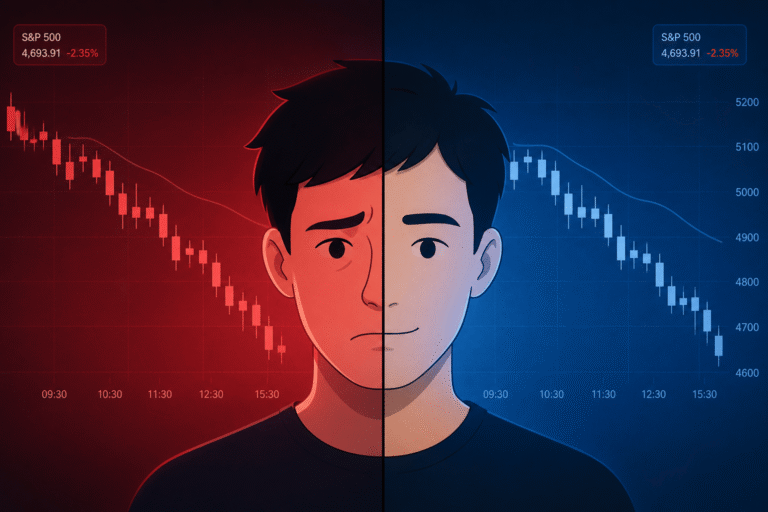

The Drifter Investor: Why Potential Without Direction Can Hold Investors Back
Why Some Investors Struggle to Stay Consistent
At Pathidon, we believe investing is deeply connected to personality.
Two people can buy the exact same investments and still experience completely different results — not because of intelligence, but because of how they emotionally respond to volatility, uncertainty, risk, and decision-making.
That’s why we believe there are five core investor personality types:
- The Guardian
- The Navigator
- The Builder
- The Explorer
- The Drifter
Each personality approaches investing differently. Some prioritize safety. Some seek balance. Others focus on long-term growth or discovering new opportunities.
The Drifter is unique.
Unlike the other personalities, the Drifter is not defined by a clear investing philosophy. Instead, they often move between ideas, strategies, and emotions without a consistent framework to guide their decisions.
This doesn’t mean they lack potential.
In fact, many Drifters become strong investors once they develop greater structure and clarity.
What Is a Drifter Investor?
The Drifter has strong potential but lacks a clear investing direction.
They often feel overwhelmed by conflicting opinions, market headlines, social media trends, and the endless amount of investing information available today.
Because of this, Drifters often ask questions like:
- “Should I buy what everyone is talking about?”
- “Am I missing out on something important?”
- “What should I actually be investing in?”
- “Why does everyone seem more confident than I am?”
Drifters are usually curious and eager to improve.
The challenge is not a lack of interest.
The challenge is turning information into a consistent long-term strategy.
How Drifters Usually Invest
Drifters often invest without a clear system.
Rather than following a long-term plan, they may react to whatever currently feels exciting, urgent, or popular.
They commonly:
- Follow market trends
- React to headlines
- Frequently change strategies
- Buy investments recommended by others
- Second-guess their decisions
For the Drifter, the biggest challenge is not knowledge.
It’s consistency.
A Real-World Example
Imagine an investor who starts with growth stocks, then switches to dividend investing after watching a few videos, then becomes interested in options trading before eventually deciding index funds are the answer.
Every new strategy feels convincing.
As a result, they continually change direction before giving any approach enough time to work.
The problem isn’t a lack of intelligence.
The problem is a lack of direction.
The Strengths of the Drifter
1. They Are Open to Learning
Drifters are often highly curious and willing to explore different investing ideas.
This openness creates enormous potential for future growth.
2. They Adapt Quickly
Because they are exposed to many different approaches, Drifters can adapt rapidly when they discover a framework that genuinely fits them.
3. They Have Significant Growth Potential
Many Drifters can dramatically improve their results simply by developing structure and consistency.
The Biggest Challenges
1. They Follow the Crowd Too Easily
Drifters can become heavily influenced by social media, financial news, friends, or popular market narratives.
2. They Lack a Consistent Framework
Without a clear process, every market movement can feel like a reason to change direction.
3. Emotions Often Drive Decisions
Fear, excitement, anxiety, and uncertainty can have a significant impact on Drifter behavior.
How Drifters Become Stronger Investors
Drifters usually become stronger investors when they stop searching for the perfect strategy and start building a consistent one.
What helps them most is:
- Developing a clear investing plan
- Understanding their investor personality
- Creating simple decision-making rules
- Focusing on long-term goals
- Reducing unnecessary portfolio changes
The goal is not to know everything.
The goal is to know enough to act consistently.
Once Drifters develop structure and confidence, they often discover that they were never lacking potential — they were simply lacking direction.
Their greatest opportunity is not finding the perfect investment.
It’s finding a framework they can trust.
Final Thought
Modern investing has never offered more information.
Yet many investors feel more confused than ever.
Every day brings new opinions, new predictions, and new opportunities competing for attention.
The Drifter often feels caught in the middle of that noise.
But being a Drifter is not a permanent identity.
It is often the beginning of an investing journey.
Once Drifters develop clarity, structure, and confidence, they frequently become far more disciplined investors than they ever imagined possible.
Sometimes finding the right direction is the most important investment decision of all.
Recommended Reading for Drifters
A book many Drifters naturally connect with is The Psychology of Money by Morgan Housel.
Rather than focusing on stock picking or complex strategies, the book explores how behavior, decision-making, and emotional discipline influence financial outcomes. Its emphasis on building a healthy relationship with money and investing aligns closely with the challenges many Drifters face.
Disclaimer: This section may contain affiliate links, meaning Pathidon may earn a small commission at no extra cost to you.


Stefan Theron
Founder of Pathidon
Stefan holds a degree in Psychology and an MBA, and has spent years studying behavioral finance, market psychology, and the decision-making patterns that shape how people invest — bridging the gap between financial knowledge and human behavior.