How to Stop Treating Investing Like Gambling
You buy a stock because you think it’ll go up. It rises 10%, and suddenly you feel like a genius. Then it falls 8%, and you’re checking your phone every few minutes.
Another stock catches your eye — everyone’s talking about it, so you buy in. It jumps 15%, and now you’re convinced you’ve got a real talent for this.
Now you want to win the money back.
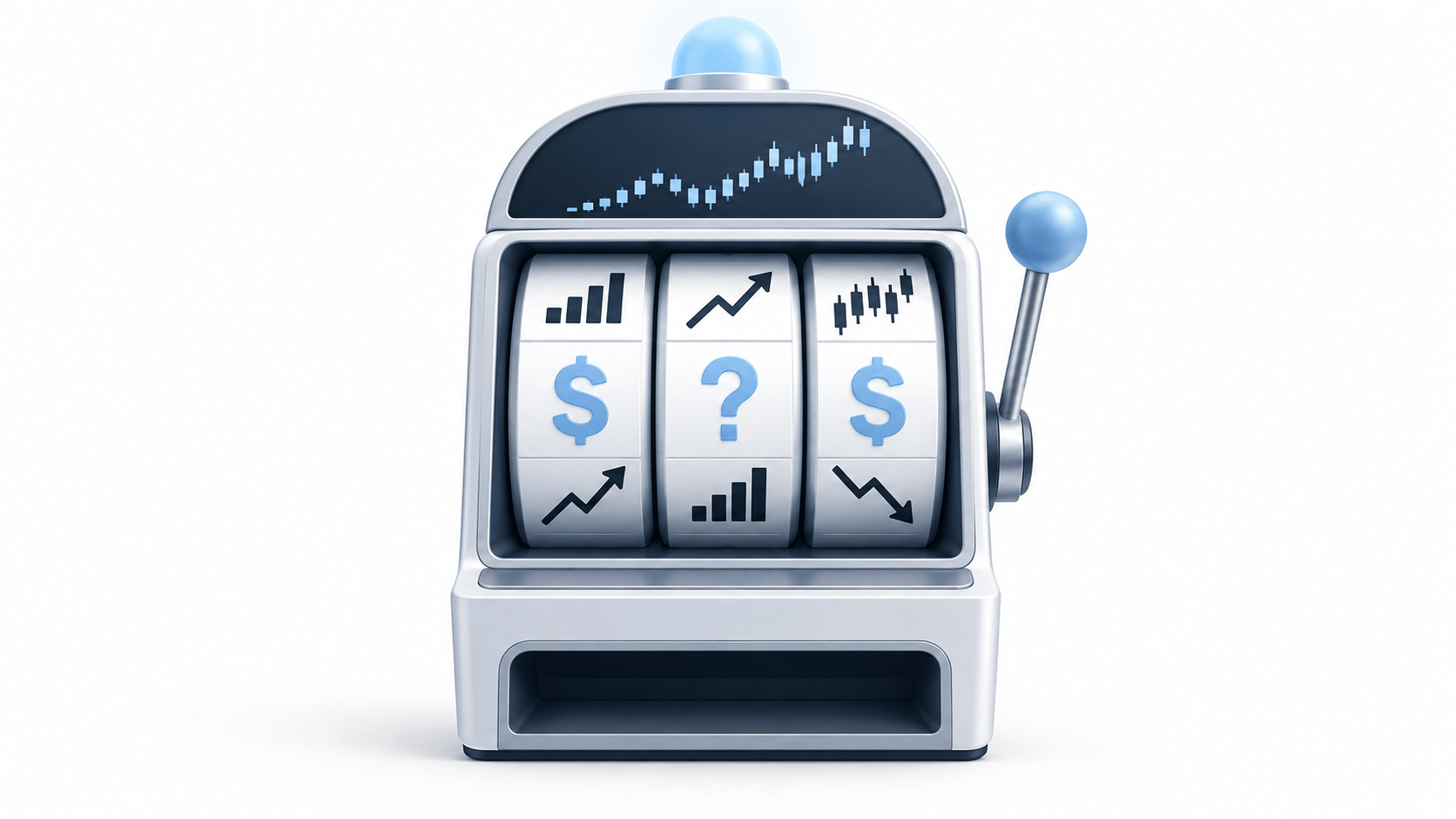
Somewhere in there, you stopped investing according to a plan and started playing a game. And the line between the two — investing and gambling — is a lot blurrier than most people think.

Why Investing Can Feel Like Gambling
The market doesn’t need to be a casino for your brain to treat it like one. Investing and gambling share the same raw ingredients: uncertainty, risk, money, unpredictable outcomes. What separates them isn’t the ingredients — it’s how you respond to them.
A long-term investor accepts that any single outcome is unpredictable and builds a process meant to work across many decisions. A gambler fixates on the next one. And markets, unfortunately, are very good at rewarding that short-term instinct — at least often enough to keep you hooked.
You start chasing wins. A stock rises after you buy it, and your brain quietly files that as proof you made a good call. But a profitable outcome doesn’t mean it was a good decision — sometimes you were right, sometimes you were just lucky. That gap is called outcome bias: judging a decision by what happened afterward rather than by the reasoning behind it. Start equating winning with being right, and you’ll find yourself getting more confident, taking bigger positions, and reaching for more risk than you’d normally accept.
You start chasing losses. This one’s more dangerous. You lose $500 and think, I’ll just make it back. So you take another position. Then another. Somewhere along the way, the goal quietly shifts from making a good investment to recovering what you lost. But the market has no memory of your loss — it doesn’t owe you a comeback. The question that actually helps here isn’t “how do I get my money back?” It’s “knowing what I know now, what’s the best decision from here?”
Build a Process Instead of Chasing Predictions
The simplest fix is to stop making every investment about predicting the next price move. That means changing the question you’re asking yourself:
Instead of:
“Will this stock go up?”
Ask:
“Why am I buying this?”
Instead of:
“How much can I make?”
Ask:
“What could make me wrong?”
Instead of:
“Should I sell because it dropped?”
Ask:
“Has anything actually changed about the reason I bought it?”
Each of these shifts your attention from the outcome back to the decision — which is a much healthier place to invest from, because it’s the only part you actually control.
Make Your Strategy Boring
Good investing is often boring, almost by design. You contribute regularly. You diversify. You rebalance occasionally. You get on with your life while the market does whatever it’s going to do regardless of your opinion on it.
If you’re constantly checking prices, hunting for the next hot stock, or feeling itchy when you aren’t trading — something’s shifted. You might not be chasing returns anymore. You might be chasing stimulation. And the ability to just do nothing is one of the most underrated skills in investing. You don’t need an opinion on every stock, you don’t need to catch every opportunity, and you definitely don’t need to trade just because the market happens to be moving.
Give Your Emotions Less Power
None of this means becoming emotionless. You’ll feel fear when markets fall, excitement when they rise, regret when you miss something — that’s all normal. The goal isn’t to stop feeling those things. It’s to stop treating every feeling as an instruction.
You can feel afraid without selling. You can feel excited without buying. You can feel regret without trying to win the money back. Emotional discipline was never about controlling what you feel — it’s about controlling what you do next.
Final Thought
Investing starts to resemble gambling the moment the focus shifts from building wealth over time to winning the next decision. The fix isn’t eliminating risk or emotion — it’s building a process that doesn’t depend on predicting what happens next.
There will always be another hot stock, another exciting story, another opportunity that makes you feel like you’re missing out. You don’t have to participate in all of them. Good investing was never about winning every time — it’s about making decisions you can keep trusting, even when you have no idea what happens next.
Recommended Reading
Fooled by Randomness by Nassim Nicholas Taleb.
Taleb examines how easily we mistake luck for skill, especially when outcomes are uncertain. It’s particularly relevant to investing because a profitable decision isn’t necessarily a good decision—and a losing decision isn’t necessarily a bad one.
If you’ve ever wondered whether you’re genuinely making smart investment decisions or simply getting lucky, this book is worth picking up.
Disclosure: Some links in this article may be affiliate links, meaning Pathidon may earn a small commission at no extra cost to you.

Stefan Theron
Founder of Pathidon
Stefan holds a degree in Psychology and an MBA, and has spent years studying behavioral finance, market psychology, and the decision-making patterns that shape how people invest — bridging the gap between financial knowledge and human behavior.