Investment Taxes Explained for Beginners (Capital Gains, Dividends & More)
Investment Taxes Explained for Beginners
When people first think about investing, they usually focus on returns.
But there’s another side to that question:
“How much do I keep after taxes?”
For many beginners, this is where things start to feel complicated — and even a bit intimidating.
But here’s the truth:
Investment taxes are usually much simpler than they seem.
You don’t need to know everything upfront.
You just need to understand the basics — and how they apply to you.
Why Do Investment Taxes Exist?
In simple terms, governments tax investment income just like they tax regular income.
If you earn money from:
- A job → you pay income tax
- An investment → you may also pay tax
Think of it like this:
Investments are another way of earning money — so they’re taxed too.
But not all investment income is taxed the same way.
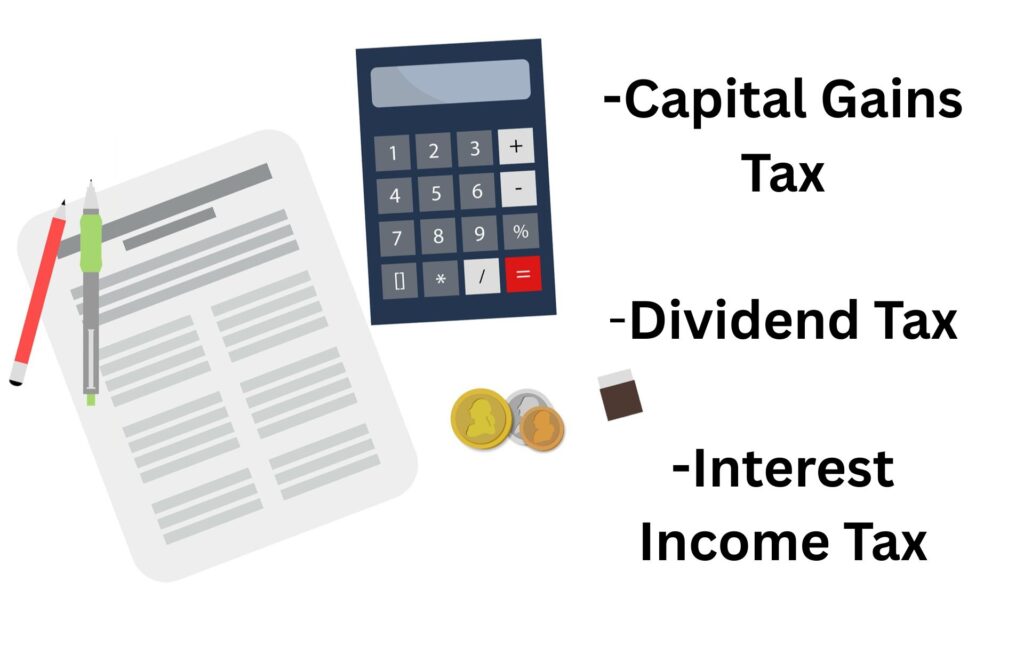
The 3 Most Common Types of Investment Taxes
1. Capital Gains Tax (When You Sell for a Profit)
You pay capital gains tax when:
- You sell an investment
- And you made a profit
Simple example:
- You buy a stock for $100
- Later, you sell it for $150
- Your profit = $50
You may pay tax on that $50 gain
Typical guideline range (varies by country):
- Around 0% – 20% in many systems
- Sometimes lower for long-term investing, higher for short-term trades
Important: These are general examples, not exact rates or financial advice.
2. Dividend Tax (Income While You Hold)
Some investments pay dividends — regular cash payments.
Simple example:
- You receive $10 in dividends
That amount may be taxed
Typical guideline range:
- Around 10% – 30%
Think of dividends like:
“Income your investments pay you while you wait.”
3. Interest Income Tax
Applies to things like:
- Bonds
- Savings products
- Certain funds
Simple example:
- You earn $20 in interest
That may be taxed as income
Typical guideline range:
- Around 10% – 40%+, depending on your income level
A Simple Way to Think About Investment Taxes
Instead of memorizing rules, use this simple framework:
You are usually taxed when money comes to you
That could be:
- When you sell (capital gains)
- When you receive income (dividends or interest)
If nothing is sold and nothing is paid out,
often there’s no immediate tax.
Are There Tax-Free Investments?
Yes — but this is where many beginners get confused.
It’s usually not the investment itself that is tax-free.
It’s the account or system you invest through.
Tax-Advantaged Accounts (Where Taxes Are Reduced or Eliminated)
Examples:
Different countries offer special accounts that allow your investments to grow with little or no tax.
- 🇺🇸 Roth-style accounts
→ Growth and withdrawals can be tax-free (if rules are followed) - 🇬🇧 ISA (Individual Savings Account)
→ No tax on gains or dividends - 🇿🇦 Tax-Free Savings Account (TFSA)
→ Tax-free growth within limits - 🇰🇷 ISA / IRP accounts
→ Reduced or deferred tax benefits
In these accounts:
- You can still invest in normal assets (stocks, ETFs, etc.)
- But the tax treatment is different
How This Differs From Normal Investing
| Normal Account | Tax-Advantaged Account |
| Taxes on gains and income | Reduced or no taxes |
| Pay tax when you sell or receive income | Often delayed or eliminated |
| Fewer restrictions | May have contribution or withdrawal rules |
Same investments — different tax outcome.
Do Taxes Work the Same Everywhere?
Not exactly.
Each country has its own rules:
- Some reward long-term investing with lower taxes
- Some offer tax-free accounts
- Some have minimum thresholds before tax applies
But the core idea remains the same:
profits and income from investments may be taxed.
What About Investing Internationally?
If you invest in foreign markets, you may encounter:
- Withholding taxes (taken before you receive dividends)
- Double taxation agreements (to prevent being taxed twice)
Simple example:
- You receive a $10 dividend from a foreign stock
- $2 is withheld before it reaches you
You receive $8, and your home country may apply its own rules
Many brokers handle part of this automatically, which simplifies the process.
Real-World Analogy: Taxes as a Small Share of Your Growth
Think of investing like growing a tree.
- Your investment is the seed
- Time and consistency help it grow
- Taxes are like trimming a small portion of the branches
The tree still grows —
you’re just sharing a small part of the growth along the way.
Where to Learn the Rules That Apply to You
Since tax rules depend on where you live, it’s worth checking reliable sources:
- Official tax authorities:
- Internal Revenue Service
- HM Revenue & Customs
- National Tax Service
- Broker education sections:
- Fidelity Investments
- Charles Schwab
- International tax frameworks:
- OECD
You don’t need deep expertise —
just a clear understanding of the basics in your region.
Final Thought
Taxes can seem like a complicated barrier at first.
But in reality, they’re simply a normal part of earning through investing.
They don’t stop your progress.
They don’t remove the power of compounding.
They just take a small share along the way.
The goal isn’t to master every rule or avoid taxes completely.
It’s to understand enough to invest with confidence.
Because at the end of the day, consistent investing over time matters far more than perfect tax optimization.
And once you see taxes as something manageable — not something to fear —
they become just another small part of a much bigger, long-term journey.
Disclaimer: This article is for educational purposes only and does not constitute financial or tax advice. Tax rules, rates, and regulations vary by country and individual circumstances, so the examples and ranges provided are general guidelines and may differ in your specific situation.

Stefan Theron
Founder of Pathidon
Stefan holds a degree in Psychology and an MBA, and has spent years studying behavioral finance, market psychology, and the decision-making patterns that shape how people invest — bridging the gap between financial knowledge and human behavior.