Loss Aversion in Investing: Why Losing Money Hurts More Than Gaining
Why losing $100 hurts more than gaining $100 feels good.
If you’ve ever felt a knot in your stomach after seeing an investment go down—even a little—you’ve already met loss aversion. It’s one of the strongest psychological forces in investing, and for beginners, it’s often the most dangerous.
Loss aversion doesn’t just influence how we feel. It quietly shapes our decisions, pushes us to act too soon, or freezes us when we should act at all. Understanding it is one of the first real steps toward becoming a calmer, more consistent investor.
What Is Loss Aversion?
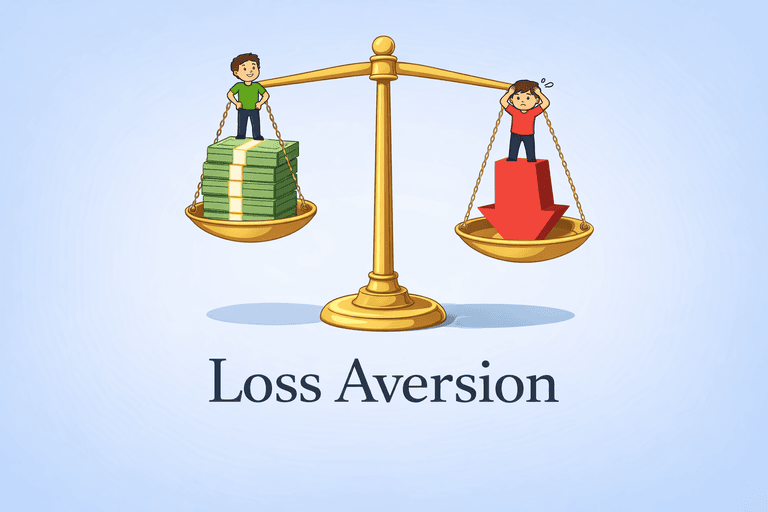
Loss aversion is the idea that losses feel more painful than gains feel pleasurable, even when the amounts are the same.
Losing $100 doesn’t feel equal to gaining $100.
It feels worse—often much worse.
Psychologists have found that, on average, a loss feels about twice as powerful as an equivalent gain. Your brain treats losses like threats, triggering stress and fear responses that were once useful for survival and needed to be acted on quickly—but are often harmful for long-term investing and smart investing.
This isn’t a flaw. It’s normal human nature.

A Simple Real-Life Example
Imagine this:
- You find $100 on the street. You feel happy.
- A week later, you lose $100 from your wallet. You feel frustrated, annoyed, maybe even angry.
Most people remember the loss more vividly than the gain—even though the net result is zero.
Now apply this to investing.
A great example is when Amazon’s stock dropped more than 50%. Negative news flooded in, and loss aversion kicked in. The pain of watching the stock fall made selling feel like the responsible choice—even though the company continued operating, growing revenue, and expanding its business over time.
What follows is the part loss aversion tends to hide.
In the years after that decline, Amazon’s stock not only recovered, but eventually moved well above its prior peak. Investors who endured the temporary loss were rewarded, while many who sold during the downturn permanently locked in their losses.
This is not an isolated incident. Smart investors understand loss aversion, expect short-term discomfort, and avoid letting temporary declines dictate long-term decisions.
How Loss Aversion Shows Up in Investing
Loss aversion rarely announces itself. It shows up quietly, disguised as “logic” or “being cautious.”
Here are the most common ways beginners experience it:
1. Selling Too Early
You buy a stock. It drops 5%.
Your discomfort grows, and you sell just to stop the pain—often right before the price recovers.
The goal becomes avoiding loss, not building wealth.
2. Holding Losers Too Long
Selling would mean admitting a loss, and that feels painful. So you wait, hoping the price will return to where you bought it—even if the original reasons for investing no longer make sense.
The loss isn’t just financial. It becomes emotional.
3. Avoiding Investing Altogether
After experiencing a loss, some beginners stop investing entirely. The fear of feeling that pain again outweighs the potential for future gains.
Inaction feels safer—but it often costs more over time.
Why Beginners Are Especially Vulnerable
Beginners haven’t yet built emotional calluses.
When you’re new:
- Every dollar feels personal
- Every dip feels like a mistake
- Every red day feels like danger
Without experience, the brain interprets normal market movement as failure. That failure can even seem personal. Loss aversion fills the gap where understanding and confidence haven’t formed yet.
This is why education matters more than stock picks early on. Educate yourself, study the stock, study the stock market, and make informed decisions, not on what is trending or emotional.
The Long-Term Cost of Loss Aversion
Loss aversion doesn’t usually cause one big mistake.
It causes many small ones.
- Selling during short-term volatility
- Missing rebounds
- Constantly switching strategies
- Chasing “safer” options at the wrong time
Over years, these behaviors compound—just not in your favor.
Ironically, trying to avoid losses often leads to lower long-term returns.
How to Work With Loss Aversion (Not Fight It)
You don’t eliminate loss aversion. You manage it.
Here’s how:
- Expect discomfort: Feeling uneasy during downturns doesn’t mean you’re doing something wrong. Focus on your fundamentals and the logical information of the stock.
- Zoom out: Judge performance over years, not days or weeks. See that dips are natural.
- Decide in advance: Set rules when you’re calm, not when markets are volatile. Stay with your rules and again, your fundamentals.
- Separate feelings from actions: You can feel fear without acting on it. Do not let your emotions guide you.
The goal isn’t to feel nothing—it’s to act wisely despite feeling something. It is also to use that feeling to learn and become better.
Final Thought
Loss aversion isn’t your enemy because it exists.
It’s your enemy when it quietly controls your decisions.
Every successful investor learns this lesson sooner or later: short-term pain is often the price of long-term progress. When you understand why losses hurt so much, you gain the power to pause, reflect, and choose a better response.
And that—more than any stock tip—is what truly moves you forward.

Stefan Theron
Founder of Pathidon
Stefan holds a degree in Psychology and an MBA, and has spent years studying behavioral finance, market psychology, and the decision-making patterns that shape how people invest — bridging the gap between financial knowledge and human behavior.